Hey Besties! Regardless of what level cookie decorator you are, we ALL learned how to flood cookies! Or maybe you’re just starting and are about to learn! It’s the first real essential cookie decorating skill to learn and teaches so much about how royal icing behaves. Some cookiers pick it up really fast, but that is definitely not the majority. So if your cookies started out lumpy or spilling over, you’re in good company, Bestie. But my goal is always to help fellow home bakers skip the hard parts and get to the rewarding parts as quickly as possible. So today we’re covering the 3 most common challenges cookiers face when flooding cookies. We’re diving deep into these three and how you can fix them for a perfect flood. Let’s go!
Royal Icing recipes
So here’s the thing about royal icing…it’s a pretty short list of ingredients. Meringue powder (or egg whites), water, powdered sugar and most of today’s cookiers include flavoring and light corn syrup. But HOW you put these ingredients together can make a world of difference in the icing you create. It’s something that no one really talks about, but I like to remind cookiers of. We all talk about royal icing as if we’re using the same icing, but if you made 10 different recipes, you’d end up with wildly different icing. Why is this important? Because cookie decorating is all about mastering your icing and how to manipulate it. What works for one cookier may not work for you and vice versa. But there are some universal truths in how royal icing behaves and that is the knowledge you need! That’s what we’re covering today.
I use the same royal icing recipe every day for all my cookie decorating. I walk through it HERE and it’s very simple to make with just a few important steps. If you need a fabulous recipe or if you’re current recipe is giving you grief, I definitely recommend trying the one I use. And remember, you’re never married to a recipe! There’s no reason to stick with one that’s not giving you the results you want. You’d be amazed at how trying a different recipe can make all the difference for you. I hear it ALL the time.

Let’s talk flooding
Learning how to flood cookies is most commonly your first real decorating skill and I always recommend new decorators start there. Don’t expect to just recreate some cookie design you saw if you’ve never worked with royal icing before. That’s a recipe for tears, frustration and curse words, trust. If you want to create beautiful cookies, focus on the foundations first and your journey will accelerate much quicker.
Most decorated cookies have a flood layer, or they have sections flood layers. Of course, there are other techniques where flooding won’t be involved, but the vast majority of time, flooding is involved. So the first hurdle is starting to learn your consistencies. Cookie decorating is really all about icing consistencies. I have a comprehensive consistency guide HERE which not only shows the consistency I use to flood, but other consistencies as well, so bookmark for the future!
I personally use one consistency to outline and flood my cookies for a seamless look. But that is not the only way! I recently published THIS video which shows different consistency methods so you can find what works best for you. There is no right or wrong here, you decide. I’ll always give you options, Bestie.
3 most common flooding challenges
So we all want that perfectly smooth, flat, polished icing surface, right? I get it! And you’ll master it. But through this journey, I receive A LOT of messages and frustrated cookiers looking for help. And it is almost always due to one of these 3 challenges. Let’s cover each and how to fix them!
Royal Icing is too thin
We’ll start with the most common! If your icing is running over the edge of your cookie, your icing is simply too thin, or you’re adding too much icing. Most cookiers flood with a consistency in the range of 10-15 seconds. What does that mean? This is a timing method that is used universally in the cookie decorating world to help communicate consistencies. So if someone says a “15-second consistency,” it means that when the icing was in the bowl, they ran a knife through it, to “cut” the icing, and it took 15 seconds for the icing to return to perfectly smooth in the bowl. So a 5-second consistency would be much thinner, and a 30-second consistency would be thicker. Look at that, you’re already talking the cookier lingo now!
If you’re flooding with a piping bag and your icing is less than 10 seconds, there is a very good chance it’s going to spill over the edge. If you’re encountering this, simply make your icing a little bit thicker. Use a timer to really ensure you’re icing is the consistency you think it is. I recommend a 12-15 second icing for a consistency that’s easier to control.
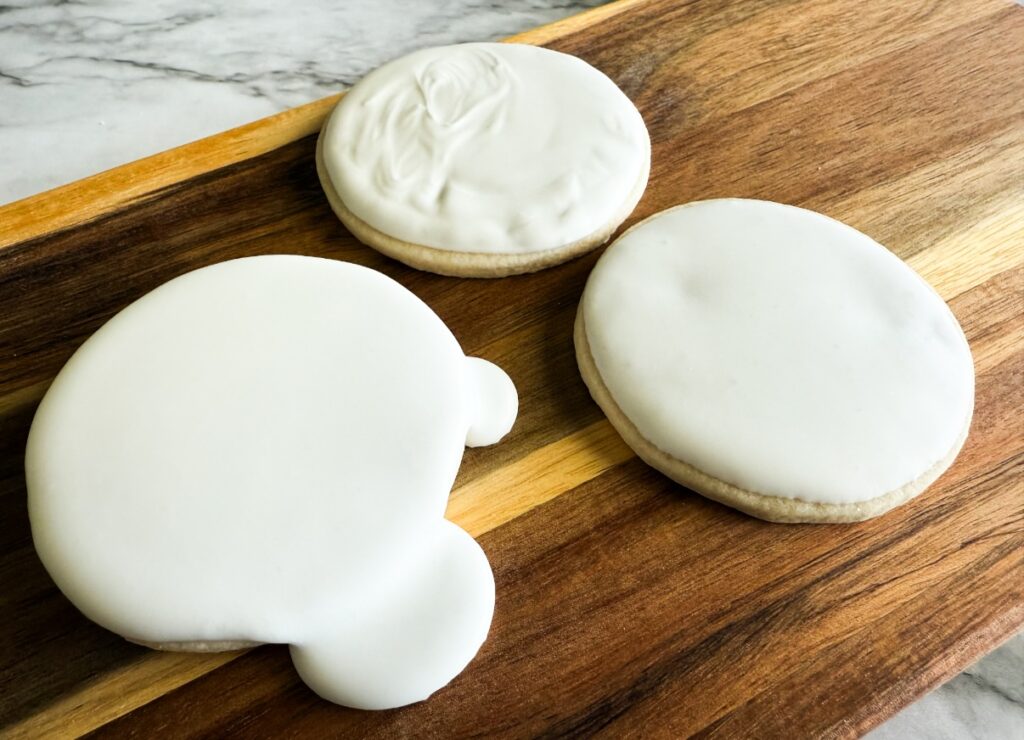
And just don’t overload your cookie! Flood a layer, look at it from an angle to ensure its smooth. If it’s not, you can add a little more in low spots. But it’s always easier to add more icing versus taking it away. Here is an example of a cookie where the flood was too thin and spilled over.

Royal icing is too thick
Let’s swing the pendulum to the other side! Many cookiers are so scared of the dreaded spillover, they try to play it safe with thicker icing. Unfortunately, if your icing is too thick, it’s not going to settle smooth like you want. Take a look at this example where the icing was too thick.

The fix? Thin your icing to find that good flood consistency. I always use and recommend using a spray bottle of water to make your consistencies. This gives you precise control over how much water you’re adding. Sometimes creating the perfect consistency can just be the difference of 1 or 2 sprays of water! But once you learn it, you’ll be golden.
Another tip: If you flood your cookie and you can still see peaks or scribe marks in your icing, it’s too thick. Flood your cookie and look at it from a side angle. If it hasn’t settled smooth within about 30 seconds, it’s not going to. That’s when you know you should stop and adjust your consistency, or you’ll be fighting it the whole time.
not enough royal icing
And the third most common challenge is not using enough icing! This is actually extremely common and is also born out of the fear of spilling over the edge. Cookiers tend to play it safe to avoid the spillover but instead end up with divots and low spots in their flood. Like in this example:

If you are using your scribe to spread out the icing to cover the cookie, you’re not using enough icing. You simply need to use more when flooding to achieve that smooth surface. Look at your icing from a side angle and if there are low spots or divots, add a little icing just to those areas while your flood is still wet.
Let’s see these in action!
I made a video for you to see exactly how these icing challenges occur, along with how I flood my cookies for a nice smooth surface. To watch on Youtube, click HERE or the cookie image below. If you’d prefer to watch on Tiktok, click HERE! I hope the photos above; tips and this video visual are helpful for you in mastering how to flood cookies!

Was this helpful?
I hope this post all about the most common mistakes in learning how to flood cookies was helpful! These are all super common and almost every single cookier encounters these early on in their cookie journey. Fortunately, just small tweaks make all the difference! And if you need any more help, you can find me and thousands of other fabulous and helpful Besties in our community HERE!
And if this was helpful, make sure you’ve subscribed to receive my weekly newsletter, so you never miss out on new recipes, tutorials, tips, techniques, product recommendations and free printables! Happy Baking, Bestie!